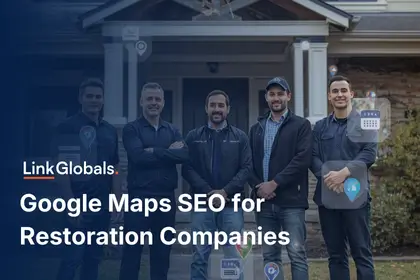
Why Google Maps Matters More Than SEO for Restoration Companies
If you run a water damage restoration or mold removal business, Google Maps is where your real leads come from — not blog traffic, not social media, not vanity rankings.
When a homeowner searches:
- “water damage restoration near me”
- “emergency water removal Florida”
- “mold remediation company”
Google shows Maps results first.
And the top 3 listings (the Map Pack) get the majority of calls.
If you’re not there, you’re invisible.
This guide explains how Google Maps SEO actually works for restoration companies, why most businesses fail to rank, and what you need to do to consistently appear in the top results — especially in competitive Florida markets.
How Google Maps SEO Works (In Simple Terms)
Google Maps rankings are based on three core factors:
1. Relevance
How closely your Google Business Profile matches the search.
2. Distance
How close your business appears to be to the searcher.
3. Prominence
How trusted and authoritative your business looks online.
Most restoration companies obsess over distance — and ignore the other two.
That’s a mistake.
You cannot control distance, but you can dominate relevance and prominence.
Why Restoration Companies Struggle to Rank in Google Maps
After working with restoration businesses across Florida, the same problems appear again and again.
❌ Poor Google Business Profile Setup
- Wrong primary category
- Missing services
- Weak or generic descriptions
- No service-area optimization
❌ No Local Authority Signals
- Inconsistent citations
- Low-quality backlinks
- No local relevance outside the website
❌ No Location-Based Strategy
- One generic service page
- No city-focused content
- No internal geo-structure
❌ Weak Engagement Signals
- Few or no reviews
- No review strategy
- No ongoing activity on GBP
Google doesn’t trust inactive or poorly optimized businesses — especially in emergency-driven niches.
The Restoration-Specific Google Maps Ranking Strategy
This is where generic SEO advice fails.
Restoration companies need a different approach.
Step 1: Google Business Profile Optimization (Foundation)
Your GBP must be built for emergency intent.
Key optimizations:
- Correct primary category (Water Damage Restoration Service / Mold Remediation)
- Secondary categories aligned with services
- Fully built service list (not generic)
- Keyword-aligned business description
- Service area configured properly (not spammed)
This alone can move rankings in low-to-medium competition cities.
Step 2: Service + City Relevance (The Differentiator)
Google favors businesses that clearly serve specific locations.
That means:
- Dedicated service pages (water damage + mold)
- City-focused landing pages
- Internal linking between services and cities
- Consistent NAP signals across the web
For Florida restoration companies, this is critical.
Markets like Tampa, Orlando, and Fort Lauderdale are hyper-competitive.
Generic pages don’t survive.
Step 3: Local Authority & Trust Signals
Prominence is where most rankings are won.
Authority comes from:
- Quality local citations
- Industry-relevant backlinks
- Press mentions (when possible)
- Brand mentions across the web
Spam links don’t help.
Local relevance does.
Step 4: Reviews & Engagement (Maps Booster)
Reviews are not optional.
Google looks at:
- Review quantity
- Review velocity
- Review keywords
- Owner responses
For restoration companies, reviews mentioning:
- “emergency”
- “water damage”
- “mold removal”
- city names
…can significantly impact visibility.
Florida-Specific Google Maps Challenges
Florida is unique.
Why?
- High competition
- Frequent emergencies
- Dense service areas
- Aggressive advertisers
That means:
- Basic GBP setup isn’t enough
- City pages matter more
- Authority signals need to be stronger
- Consistency beats shortcuts
This is why restoration companies ranking in Florida usually follow structured local SEO systems, not one-time optimizations.
How Long Does Google Maps SEO Take for Restoration Companies?
Typical timeline:
- 30–60 days: Initial movement
- 60–90 days: Top 10 visibility
- 3–6 months: Map Pack competition (city-dependent)
Emergency niches move faster than normal businesses — if done correctly.
Google Maps SEO vs Paid Ads for Restoration Companies
Paid ads stop the moment you stop paying.
Google Maps SEO:
- Builds long-term visibility
- Lowers cost per lead over time
- Generates trust-based calls
- Compounds month after month
Most successful restoration companies use both, but Maps SEO is the foundation.
The Bottom Line
If your restoration business depends on emergency calls, Google Maps SEO is not optional.
Ranking in the top 3 means:
- More inbound calls
- Higher-quality leads
- Less dependency on ads
- Stronger local brand authority
But it requires restoration-specific execution, not generic SEO tactics.
Want to Know Where You Stand?
If you’re not sure why competitors outrank you, we can show you.
👉 Request a Free Google Maps & SEO Audit
We’ll analyze your listings, rankings, and local authority — and tell you exactly what to fix.